
How JMK Liège Upgraded to a Multi-Level Go-Kart Track

In 1996, Serge Goisse opened his first indoor karting track with a few tires in an industrial hall, a trailer with a fridge at the start line and second-hand karts shipped in containers from England. Thirty years later, JMK Karting Liège runs a 552-meter multi-level go-kart track designed and built by 360 Karting.
Our case study video shows the new track and the decision behind it. This article goes further. It explains how 360 Karting approached the multi-level go-kart track upgrade from a business solution perspective, drawing on the full interview with Serge.
JMK Liège at a glance
| Detail | JMK Liège |
|---|---|
| Location | Fléron (Liège), Belgium |
| Format | Rental business model with race sessions, indoor multi-level go-kart track |
| Total track length | 552 m (1,811 ft) |
| Ground floor | 338 m (1,108 ft) |
| Multi-level section | 214 m (702 ft) |
| Elevated structure width | 7 m (23 ft) |
| Capacity | 24 go-karts |
| Estimated lap time | Over 1 minute |
| Installation | 7 weeks, two shifts, finished 3 days ahead of schedule |
| Completed | June 2026 |
Key takeaways
- Built in seven weeks. Two installation shifts a day, finished three days ahead of schedule.
- One minor contact since opening, compared with one or two collisions per evening on the old flat track, according to founder Serge Goisse.
- Designed for spectators. Guests in the cafeteria can follow almost the entire layout.
It started with an empty factory
JMK began as a practical answer to a property problem. A friend of Serge’s had bought a disused factory near Namur and could not find a tenant or a buyer for its industrial halls. Indoor karting was just arriving in Belgium, with one track open near Brussels. The idea was to use the space and find out whether karting would catch on. It did, and the first JMK track opened in Floreffe in 1996.
“There was no timing system, no track marshals. There wasn’t much at all, really. It was really the early days.”
— Serge Goisse, founder, JMK Karting
The name came a few years later. To fund bigger investments, Serge brought in a partner: John Martin, an English businessman involved in a Belgian brewing and hotel group. JMK stands for John Martin Karting. The partnership lasted about 25 years. Serge bought back John’s shares five years ago and kept the name. The two still meet regularly, and Serge showed him the new track in Liège. “He was quite impressed.”
The Liège venue opened about ten years after Floreffe, in a former raw-materials storage hall of the region’s steel industry.
Who drives at JMK today
The core of JMK’s customer base is young motorsport enthusiasts, with families and company events alongside. The biggest shift Serge has seen is the number of women driving. When JMK started, karting was almost exclusively male.
Children have their own program. JMK runs a driving school for kids only, with no adults on track, partly for safety and partly for what it teaches.
“We teach them to drive, what a racing line is, what braking is, what an engine is. But it’s built on fair play and sportsmanship. Those are the words I love most about the children’s driving school.”
At the other end of the scale are drivers chasing lap times. Some of them go on to outdoor two-stroke karting at circuits such as Mariembourg and Genk. They start at JMK.
A track built for racers that had reached its limits
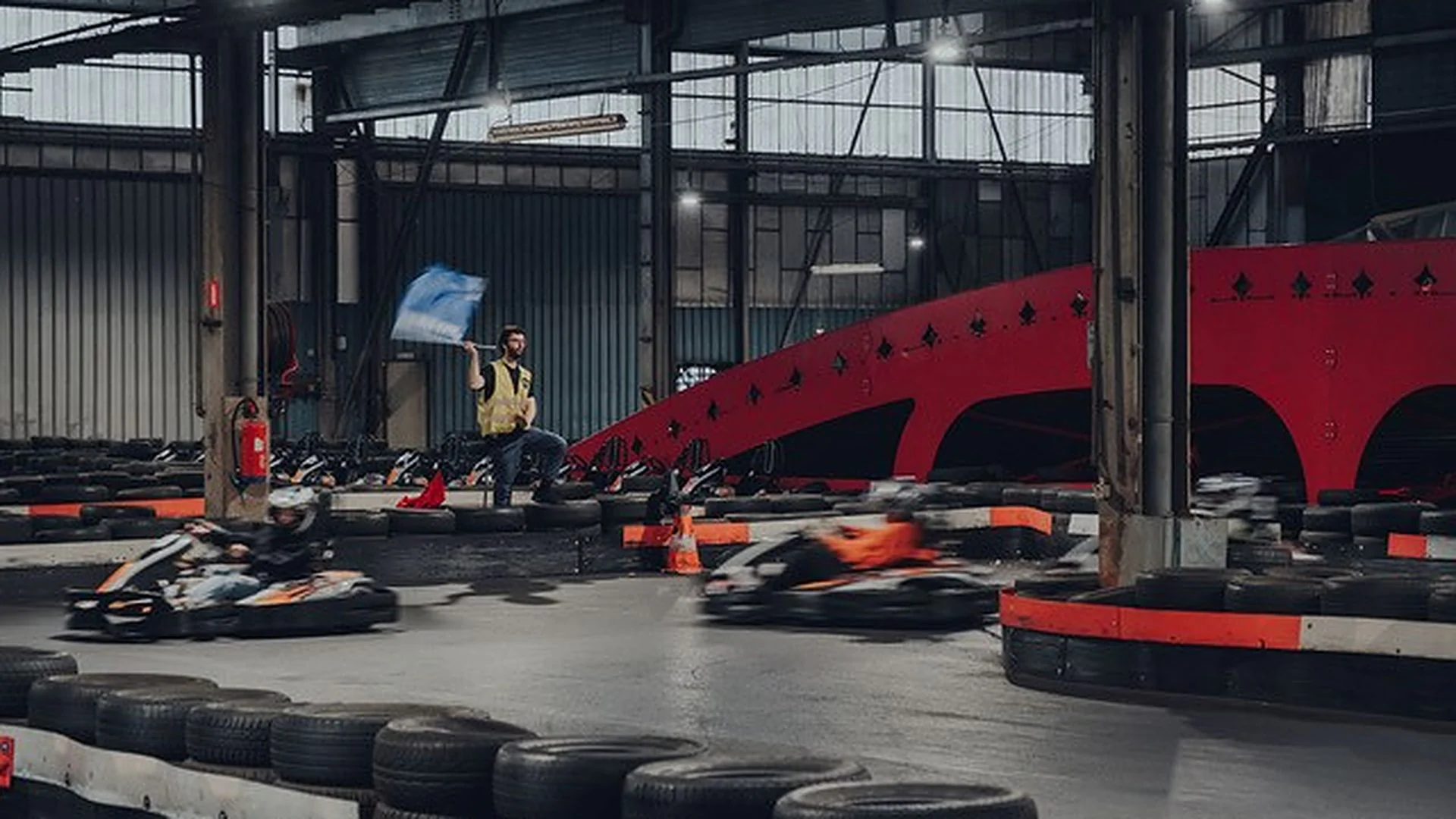
For more than 20 years, JMK Liège ran a flat first-generation layout held in place by tires backed with wooden beams. The track shifted constantly. Tires came loose, angles moved and the team regularly had to put it back in place. The bridges added over the years were built by instinct, without engineering calculations, and some slopes were tricky for anyone who wasn’t already an experienced driver.
For 360 Karting, the diagnosis was clear. The old track worked for passionate racers. It was far less suited to everyone else JMK was now attracting: families, groups, team-building events and first-time drivers.
Serge saw the same problem from a business angle.
“In any economic activity, if at some point you don’t develop the business and don’t make investments, it gradually declines.”
His options were to stop, hand the business over or invest in what he calls a “version 2.0” infrastructure for the next 10 to 20 years. What tipped the decision was his team. Some colleagues have worked with him for more than two decades, and he wanted to keep going with them.
“We built a bridge the way we thought we could. That’s why we contacted a company that specialized in this kind of development, because it’s really a profession in its own right today.”
Why JMK chose 360 Karting as its track builder
JMK talked to several track builders. The deciding factor was that 360 Karting is part of the Leading Karting Alliance, together with Sodikart and Apex Timing, so track, go-karts and timing all sit within one group.
“The choice was really made to reassure me. We’re working with a group that has mastered this business for many years and holds all of the activities within a single entity.”
The starting point: protect the racing DNA, widen the appeal
JMK runs a Rental business model: timed karting with a real racing feel that first-time drivers can still enjoy. In Liège, that model serves two very different audiences, the enthusiasts chasing lap times and a growing mix of families, groups, women drivers and young driving-school pupils.
The brief was to design one track that keeps the first group challenged and makes the second feel welcome. One part of JMK’s DNA was not up for discussion: petrol karts.
“JMK’s DNA is the gasoline kart. We’re a motorsport country, and motorsport has a combustion-engine resonance to it.”
JMK renewed its petrol operating permits, which in Belgium run for 20 years. Serge expects to add electric karts later to reach a new customer segment, with petrol remaining the core of the business.
Designing an indoor go-kart track for spectators
Serge’s most important request had nothing to do with lap times. On visits to other venues, he had noticed that the people accompanying drivers usually saw one corner and little else.
“I wanted both the customers who drive and the spectators who don’t to feel a bit like they’re in a movie theater. Everyone arrives, but everyone takes part.”
Getting that idea onto paper was a process of listening and adapting. When the early concepts didn’t yet capture what Serge had in mind, 360 Karting proposed a fresh approach and brought a second designer into the project. After one briefing, the new concept matched Serge’s vision, and it barely changed from there to construction.
“It was 360 who suggested it. I always say there’s more in three or four heads than in one. I think it was intelligently done by 360 to say, let’s bring in another mind. What came out of it is this track, which for me was what I had always imagined, even if I was unable to create it myself.”
The collaboration also ran across a language gap: Serge speaks only French. In his words, the exchange stayed constructive throughout, even when the two sides didn’t immediately agree.
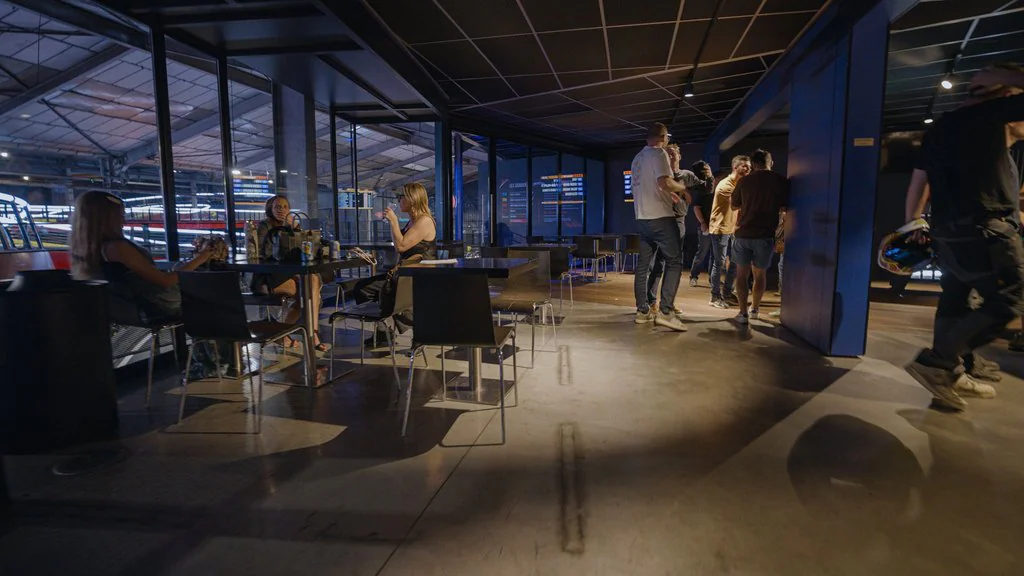
The result is a layout planned around sightlines. From the cafeteria, guests look out over the different track levels instead of a single bend. That includes children from the driving school, who can take in the whole circuit before they are old enough to drive it. It also moves JMK toward competitive socializing: a venue where groups come to compete, watch and spend time together, whether they drive or not.
Inside the multi-level go-kart track layout
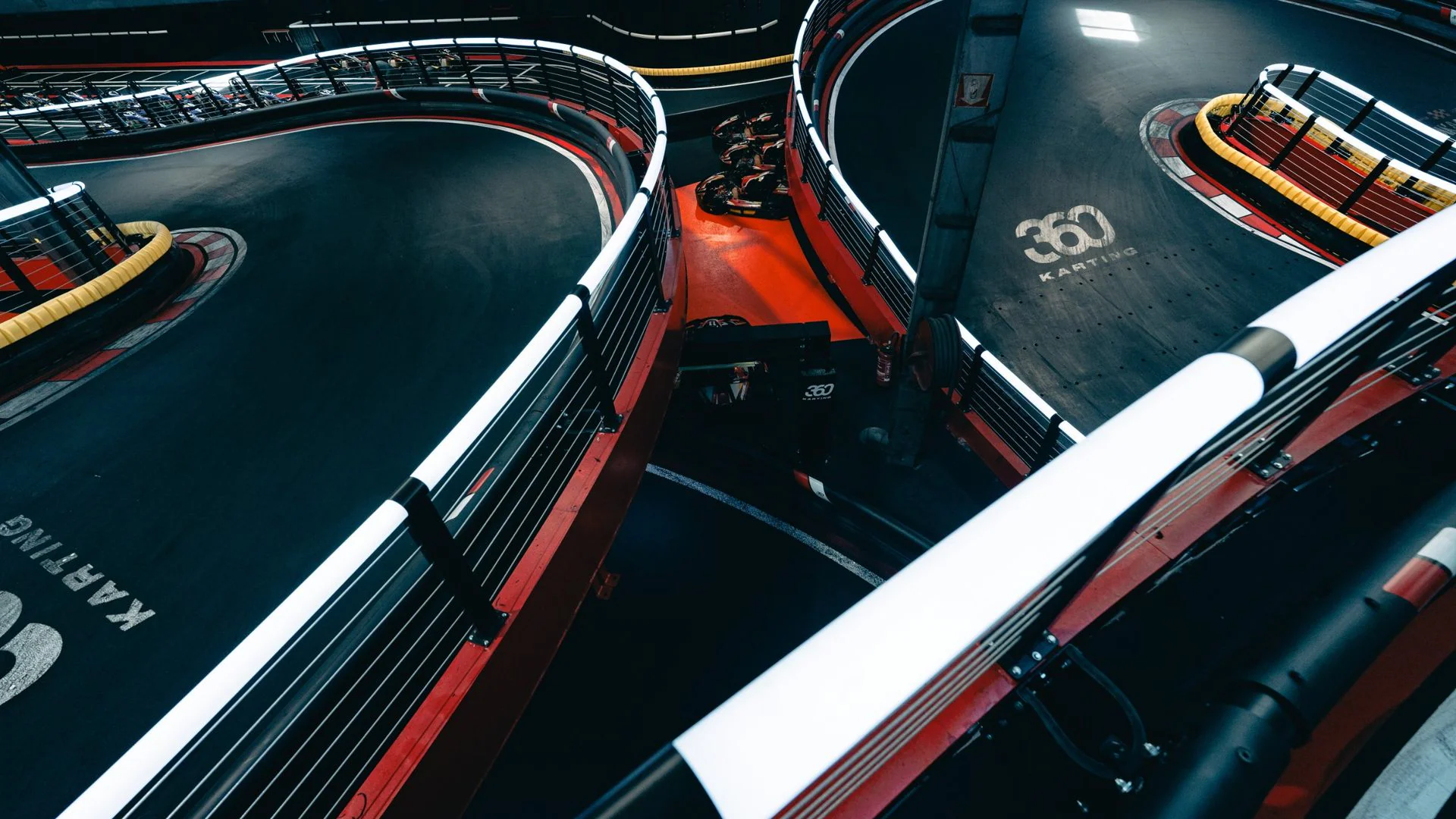
The new track is 552 meters (1,811 ft) long. 338 meters run on the ground floor and 214 meters on a multi-level track structure above it. For a venue where karting is the core business, that is the point of building vertically: more track within the same building, with the goal of more revenue per square meter.
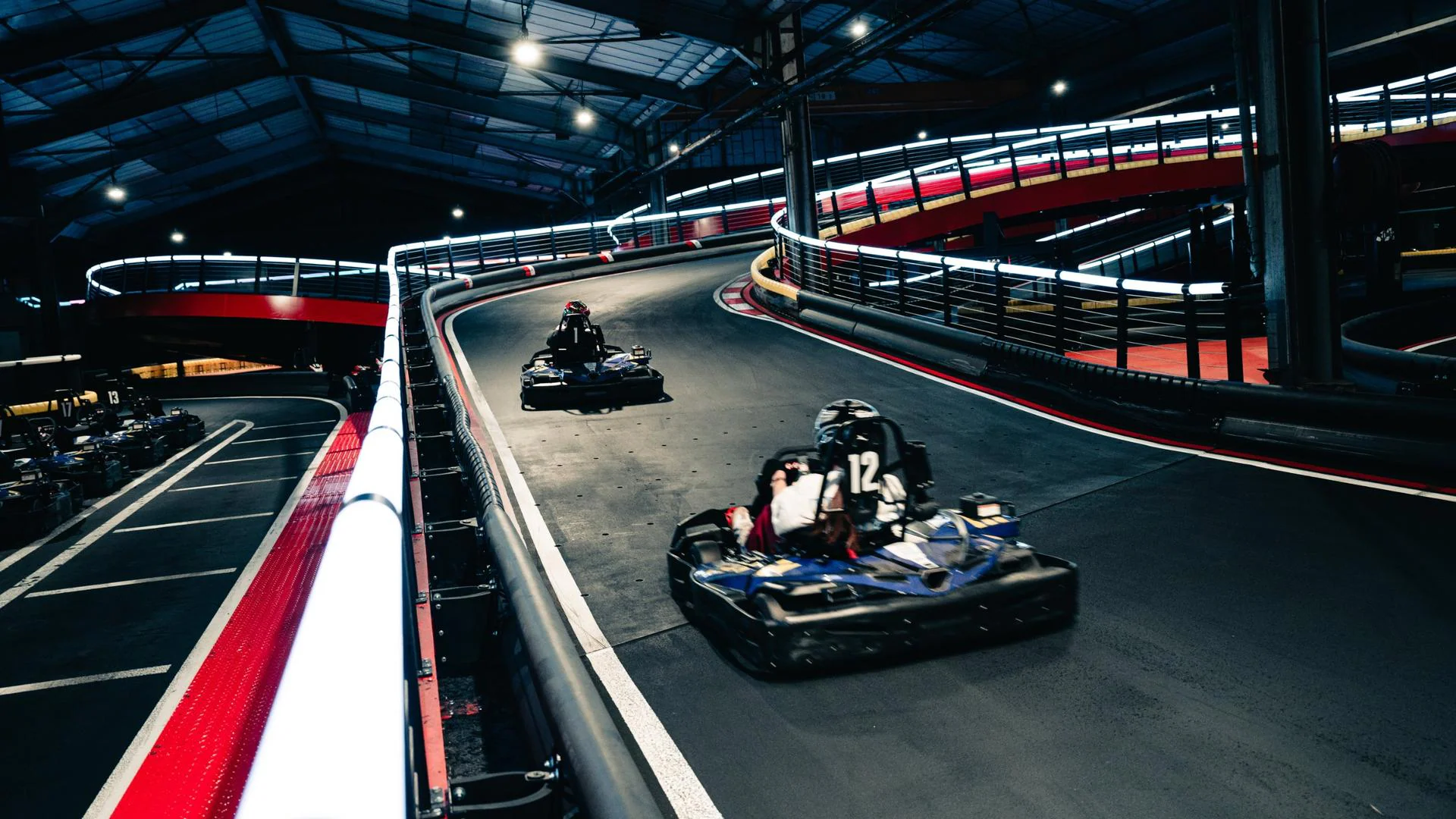
The layout combines fast, flowing sections with more technical corner sequences. A 7-meter-wide elevated module, spiral ramps and 360 SPEED+ elements give the lap a stronger rhythm. A high-compression banked-spiral-banked section adds a physical element that experienced drivers notice, while the overall flow stays manageable for first-timers.
The stacked tires are gone. In their place, the 360 ETAT barrier system protects drivers and keeps sessions running without the constant repositioning the old track needed.
Lighting completes the change. The walls are now black, and 360 ShowTime lighting built into the track traces the layout across its levels.
“Before, we lit a hall. Today, we light a track.”
Many guests tell Serge the result looks like a giant Scalextric. “Well, I bought myself my big Scalextric at fifty,” he says.
Seven weeks, two shifts, three days early
JMK could close the venue for seven weeks and not a day longer. To meet that window, 360 Karting split installation into two shifts. The morning team worked from 7:30 am to 5 pm. The evening team took over at 5 pm and stayed until 2 or 3 am.
Serge had planned an extra week of buffer, just in case. The track was finished three days ahead of schedule.
“I was the first one surprised. It let us prepare for the opening calmly.”
What changed after opening
Serge’s main concern was whether a faster, more complex layout would mean more incidents and more marshals. It turned out the other way. The track has flowed well from the start, even with around 20 karts in a session.
According to Serge, the old track saw one or two collisions almost every evening. On the new track, there has been one minor contact since the opening. For staff, that means marshals are rarely called onto the track and can focus on running sessions.
JMK did not advertise the reopening. Customers who had been loyal for 20 years came back first to see the result, and phones and social media did the rest.
“Today you don’t need to do much advertising. The customers do it for us.”
Their reaction, in Serge’s words, was simply “Wow.”
In Liège, where several karting venues have operated for many years, the new track gives JMK a clear point of difference. Serge prefers to call the other venues complementary rather than competitors: customers who discover karting at one venue often try another, in both directions.
On the business side, he is clear that this is a long-term investment.
“We’re happy with the result, happy with the feedback from customers, happy with the economic return linked to this investment. It’s not one you pay off in the short term, but the first results are very encouraging.”
Five lessons for operators planning a karting track upgrade
Build for the customers you are gaining. JMK’s audience now includes more women, children and families than when it started. The new track was briefed for all of them, not only the regulars.
Design for the people who don’t drive. Spectators, parents and colleagues are part of the visit. A layout they can follow from the cafeteria keeps them involved.
Treat flow as an operational decision. A layout that flows reduces collisions and how often staff have to step in. That matters as much as how the track looks. More on designing a go-kart track layout without flow-breaking corners.
Plan the closure as carefully as the track. A fixed reopening date shapes the whole project, from production to installation shifts.
Keep what makes your venue yours. JMK upgraded the track and the experience around it, and kept the petrol karts its customers come for.
Planning an upgrade of an existing karting track?
Every venue starts from a different building, audience and business model. Tell us about yours, and our team will help you work out what an upgrade could look like.